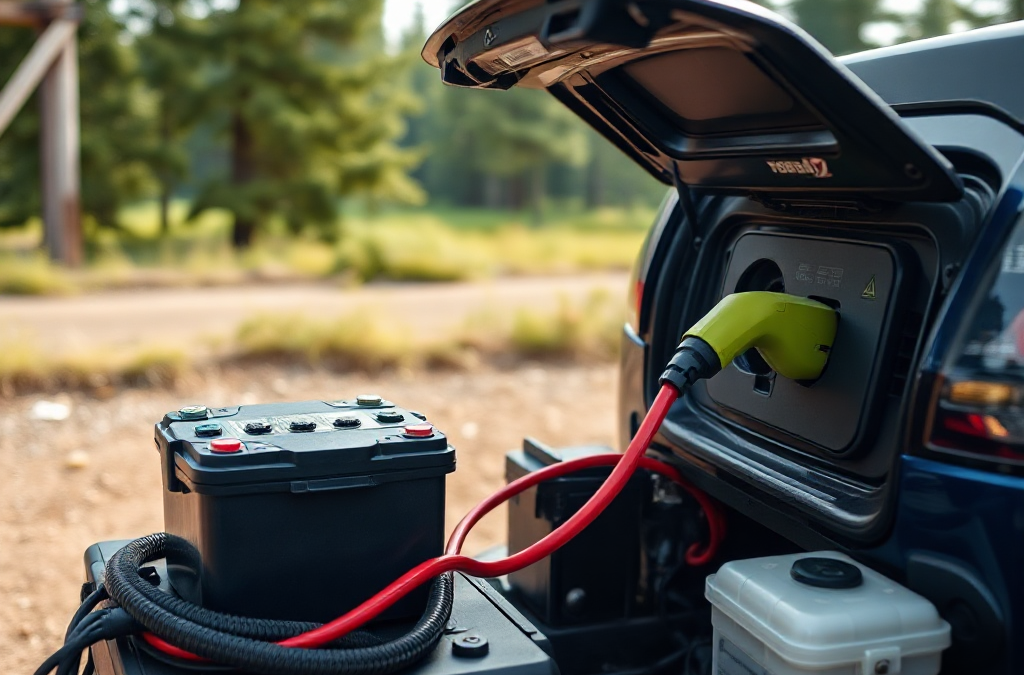
Using vehicle charging without draining the starting battery requires separating accessory loads from the engine-starting circuit, monitoring voltage, and limiting charging time to what the alternator, auxiliary battery, or portable power station can replace. A dedicated auxiliary battery with an isolator or DC-to-DC charger is the most dependable arrangement because it protects the starting battery when the engine is off. For occasional phone or tool charging, a fused accessory circuit, USB adapter, and portable power bank usually create less risk than repeatedly using the vehicle battery. Avoid judging battery condition by voltage alone, and stop charging if the engine cranks slowly, warning lights appear, wiring becomes warm, or the power source exceeds its rated output.
Why Charging Loads Can Leave a Vehicle Unable to Start
Vehicle charging becomes a starting-battery problem when phones, refrigerators, lights, inverters, compressors, or other accessories draw energy while the engine is off. The starting battery is designed to deliver a large burst of current for a short period, not to provide repeated deep discharges. A small device may appear harmless, but several hours of combined loads can reduce the reserve needed by the starter motor, especially in cold weather or when the battery is already aged.
The important distinction is between energy use and charging speed. A USB adapter may draw only a modest amount, while an inverter powering a laptop charger or household appliance can pull much more from the 12-volt system. Inverter losses add to the demand, and the vehicle’s accessory socket, wiring, or fuse may impose limits before the battery itself becomes the obvious concern. A device that works normally at the beginning of the evening can still leave insufficient starting capacity by morning.
Voltage readings also require interpretation. A battery can show a reasonable resting voltage immediately after a load is removed while having little usable reserve under a starter’s heavy demand. Conversely, a running vehicle may show alternator charging voltage without proving that the battery is healthy. A slow crank, clicking starter, dimming interior lights, or repeated need for a jump start is stronger evidence of trouble than a single meter reading.
Consider a parked vehicle running a cooler, two phones, and an inverter overnight. The cooler cycles rather than drawing its maximum continuously, but the total consumption still depends on ambient temperature, insulation, battery condition, and inverter efficiency. Assuming that the alternator will “replace everything later” is risky if the driving period is short. Recharging a depleted starting battery may require more sustained driving than a brief commute provides.

The safer principle is simple: reserve the starting battery for starting and place routine accessory demand on a source intended for cycling. That may mean a power bank for small electronics, a portable power station for larger loads, or an auxiliary battery system for regular vehicle-based use. The right option depends on duration, wattage, weather, and whether the vehicle must remain ready to move.
Charging Options That Keep Starting Power Separate
A portable power bank is usually the lowest-risk choice for phones, radios, cameras, and other small electronics. It stores energy away from the vehicle and avoids leaving a cable connected to the starting circuit. Its limitations are capacity, recharge time, and output compatibility. Check whether it supports the required USB standard and whether its stated capacity reflects usable output rather than only internal cell capacity.
A portable power station provides more capacity and may offer USB, 12-volt, and AC outlets. It is useful for laptops, medical equipment that is approved for portable use, or low-power tools, but its inverter can consume energy even when the connected appliance is idle. Keep ventilation clear, protect it from moisture, and follow the manufacturer’s limits for charging from a vehicle. A large station may need several hours of driving or a separate solar input to recover its charge.
For repeated vehicle use, an auxiliary battery is more suitable. It can be charged through a properly fused isolator or a DC-to-DC charger while keeping the starting battery electrically separate when the engine is off. An isolator may be adequate in simpler systems, while a DC-to-DC charger can provide controlled charging for battery types with different charging requirements. The installation must match the battery chemistry, cable size, fuse ratings, grounding method, and manufacturer instructions.
“Dual battery” does not automatically mean protected battery. Poorly sized cable, an incorrectly placed fuse, a failed isolator, or a manual switch left in the wrong position can connect the two batteries or create an overheating hazard. A professional installation may be appropriate when the auxiliary battery is permanently mounted, placed inside a passenger compartment, or connected to high-current equipment. Batteries also need secure mounting and suitable protection from heat and physical damage.
Solar charging can reduce dependence on engine runtime, but it is not a guaranteed replacement for an alternator or shore charger. Shade, panel angle, weather, and controller losses affect recovery. Solar works best as a supplemental source for a known daily load rather than as an assumption that a battery will always refill before the next departure. For occasional needs, a power bank is simpler; for frequent overnight loads, an isolated auxiliary system is more dependable.
Internal linking can help readers compare the options in using vehicle charging without draining the starting battery with their actual load profile instead of choosing equipment by outlet count alone.
Runtime, Wiring, And Monitoring Limits
Runtime should be estimated from watt-hours, not from battery label voltage alone. Multiply the device’s watts by the hours of operation, then allow for conversion losses and a reserve. For example, a 40-watt appliance used for five hours needs about 200 watt-hours before losses; an inverter-based setup may require more from the battery. A starting battery’s theoretical capacity is not a safe operating target because deep discharge can shorten its life and still leave the engine unable to crank.
Measure the load when possible. A plug-in watt meter, DC monitor, or manufacturer specification can reveal whether an appliance cycles, has a high startup surge, or draws power while apparently idle. A compressor cooler illustrates the difference: its average demand may be moderate, but hot weather and frequent opening can increase duty cycle. A tool charger may consume little after its battery is full, yet the inverter can continue drawing standby power.
Wiring deserves the same attention as capacity. High-current accessories need properly sized cable, secure connections, and a fuse close to the power source. A fuse protects wiring from a short circuit; it does not make an undersized cable safe. Warm connectors, melted insulation, a burning smell, intermittent power, or a fuse that repeatedly opens are stop signals, not inconveniences to bypass.
Monitoring is most useful when it combines several clues. A battery monitor that measures current and accumulated use is more informative than checking voltage during an active load. If using the vehicle’s starting circuit temporarily, set a conservative stopping point, turn off nonessential loads, and allow the engine to run only in an appropriate open-air location. Never run an engine in a garage, enclosed carport, or near openings where exhaust could enter a building.
Charging while driving is not automatically harmless. The alternator may have to supply vehicle electronics before it replenishes an auxiliary battery, and short trips may not restore the energy used. High-demand inverters can also exceed an accessory socket’s rating. Compare the appliance input, inverter output, socket fuse, charger rating, and charging-source capability before connecting them.
A practical warning list includes:
- Slow cranking or a starter that clicks instead of turning the engine.
- Battery, charging-system, or wiring warning lights.
- Unexpected voltage collapse when a load starts.
- Hot cables, loose terminals, or damaged insulation.
- An auxiliary battery that fails to charge despite a running engine.
Any of these signs calls for disconnecting the load and diagnosing the system rather than continuing until the vehicle stops starting.
A Practical Charging Decision Process
Choose the power source by asking what must be charged, for how long, and whether the vehicle must start immediately afterward. Small electronics usually belong on a power bank. Several low-power devices used during travel may fit a fused USB circuit while driving. Overnight refrigeration, lighting, or communications equipment generally deserves a portable power station or isolated auxiliary battery rather than an unattended starting-battery connection.
Use this sequence before setting up a charging arrangement:
- List the loads. Record wattage, expected hours, startup surge, and whether each device needs AC or DC power.
- Calculate a conservative energy requirement. Include inverter and charger losses, then retain capacity for temperature changes and uncertainty.
- Identify the no-start consequence. If being stranded would be unacceptable, do not use the starting battery as the planned energy reservoir.
- Check the complete electrical path. Confirm outlet, fuse, cable, connector, charger, and battery ratings.
- Test under supervision. Watch for heat, unexpected shutoff, voltage decline, or charging behavior that differs from the instructions.
A useful comparison is convenience versus isolation. Plugging a device into an existing socket is quick and inexpensive, but it provides little protection if the socket remains live with the engine off. A dedicated auxiliary system costs more and takes installation effort, yet it converts the problem from “remember to unplug everything” into a designed separation between essential and nonessential loads. Automatic low-voltage disconnects may add protection, but they should not be treated as a substitute for correct sizing or a healthy battery.
Engine idling as a charging strategy has its own drawbacks. It may produce less useful charging at low speed, waste fuel, increase noise, and create exhaust exposure. Driving solely to recharge can also fail to restore a heavily depleted battery in a short period. If the starting battery has already been discharged, use an appropriate charger or jump-start procedure according to the vehicle and battery instructions rather than repeatedly attempting to recover it through random idling.
Keep the arrangement easy to inspect. Label auxiliary connectors, secure cables away from pedals and hot exhaust components, and periodically check terminals and fuses. Test the system before a trip, not during the first emergency. Readers comparing equipment can use using vehicle charging without draining the starting battery as a reminder to evaluate isolation, capacity, and failure signs together.
For vehicle-specific charging limits, battery chemistry requirements, fuse placement, and accessory-socket ratings, consult the vehicle owner’s manual, the battery and charger manufacturers’ installation instructions, and documentation from the maker of any inverter or power station. Those sources are more reliable than a universal voltage rule because vehicle electrical systems differ.
Frequently Asked Questions
Can a phone charger drain a vehicle starting battery?
It can if left connected long enough, particularly when the battery is old, cold, partially discharged, or powering other accessories. A power bank removes that risk from the vehicle.
Is it safe to charge devices while the engine is running?
Usually, modest loads within the vehicle's rated outlets are handled while driving, but confirm the socket and charger ratings. Do not use an oversized inverter or ignore hot wiring and warning lights.
Does a second battery always protect the starting battery?
No. Protection depends on correct isolation, fusing, cable sizing, battery compatibility, and installation. A manual switch or failed isolator can still connect both batteries.
How can I estimate charging runtime?
Multiply watts by operating hours to estimate watt-hours, then add conversion losses and reserve. Use measured consumption when an appliance cycles or has a startup surge.
Should I idle the vehicle to recharge accessories?
Idling is an inefficient and potentially hazardous recovery method. Use it only where permitted and outdoors, and prefer an auxiliary battery, portable power station, or suitable charger for planned loads.
Further Reading
Authoritative Sources
- Academy of Nutrition and Dietetics
eatright.orgProfessional nutrition guidance, healthy eating resources, and practical dietitian-reviewed advice.
- U.S. Department of Agriculture
usda.govOfficial food, nutrition, agriculture, and consumer guidance from the USDA.
- NIH Office of Dietary Supplements
ods.od.nih.govResearch-based fact sheets on nutrients, supplements, dietary intake, and safety considerations.
- International Society of Sports Nutrition
sportsnutritionsociety.orgEvidence-informed sports nutrition resources and position stands for active people and athletes.
Conclusion
Protecting a vehicle’s starting battery begins with treating it as emergency starting capacity rather than convenient general-purpose storage. Match small electronics with a power bank, move larger or repeated loads to a portable power station, and use a correctly fused auxiliary battery system when vehicle charging is a regular requirement. Estimate watt-hours, account for inverter losses, inspect cable temperature and connectors, and test the setup before relying on it away from home. Short drives and engine idling may not restore what accessories consume, while voltage alone may conceal a weak battery. If the vehicle cranks slowly or the electrical system shows warning signs, disconnect the load and diagnose the fault. That approach preserves mobility while making charging more predictable.
Related Content
- The Ultimate Guide to an Effective Emergency Response Plan in 2025
- Common Pitfalls in Long-Term Food Storage: Mistakes to Avoid for Effective Preservation
- How to Prep for Blackout: Essential Checklist and Strategies
- Where can I connect with others for disaster preparedness support?
- How to Prepare for a Natural Disaster: A Step-by-Step Guide