
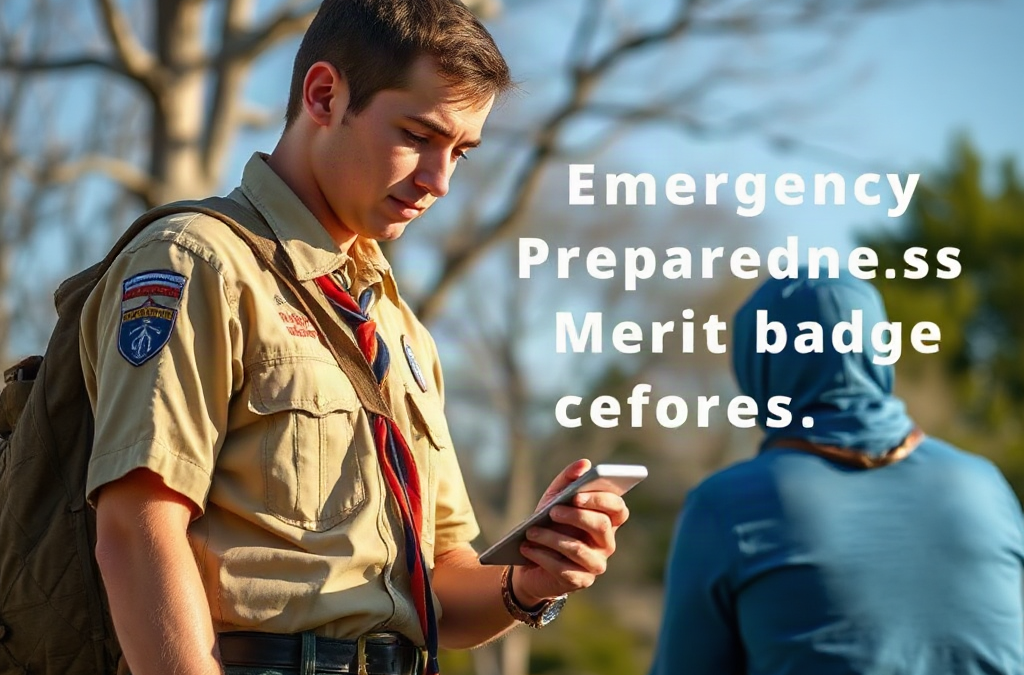
Emergency preparedness merit badge requirements explained means completing the current Scout requirements through planning, practical demonstrations, emergency-response skills, and documented preparation—not merely assembling a kit. Depending on the official version and your counselor’s instructions, the work may involve creating an emergency plan, showing first-aid or rescue knowledge, preparing for hazards, discussing communication and evacuation, and demonstrating how supplies would be used. The strongest approach is to read every requirement literally, confirm which activities need counselor approval, practice the hands-on portions before the meeting, and bring clear notes or evidence. Do not assume a household discussion or purchased equipment automatically satisfies a demonstration requirement.
What the Emergency Preparedness Merit Badge Requirements Actually Test
The Emergency Preparedness merit badge is built around applied readiness rather than memorizing emergency vocabulary. Its requirements generally ask a Scout to recognize hazards, make decisions under pressure, organize assistance, and explain how people would protect themselves before, during, and after an incident. The exact wording matters because merit badge requirements can be revised; use the current official requirement sheet and follow the version accepted by your troop or counselor.
A useful way to read the requirements is to separate them into three evidence types: knowledge, planning, and performance. Knowledge work may involve explaining emergency terms, identifying hazards, or discussing response priorities. Planning work may require a household emergency plan, an evacuation route, a communication method, or a supply arrangement. Performance work asks the Scout to demonstrate a skill, such as applying a bandage, describing rescue precautions, or showing how a response procedure would be carried out. A written paragraph cannot replace a demonstration when the requirement specifically calls for doing.
That distinction prevents a common failure: treating the badge as a shopping exercise. A purchased emergency bag can contain useful items, but it does not prove that the Scout knows when to use them, how to communicate with family members, or how to avoid creating a second victim during a rescue. Conversely, an elaborate plan may fail if it omits a person with mobility needs, a pet, medication, transportation limits, or a way to receive reliable instructions.
Read each requirement and mark the action verb. Words such as identify, explain, prepare, demonstrate, and discuss signal different kinds of preparation. Keep a working document with the requirement wording, your answer or activity, materials needed, and the counselor’s comments. The related Emergency preparedness merit badge requirements explained reference can help organize that work, but it should not replace the current official requirements.

Planning, Communication, and Evacuation Evidence
Planning requirements are strongest when they describe decisions for a specific household, not an imaginary “average family.” A credible plan identifies likely hazards in the area, places to go, routes to use, ways to contact one another, and responsibilities for people who may need extra help. The plan should account for circumstances that change the response: a blocked road, a power outage, poor cellular service, school or work separation, or an evacuation order that leaves little time to collect belongings.
Communication deserves more attention than simply listing phone numbers. A useful arrangement may include an out-of-area contact, a meeting place near home, a second meeting place outside the neighborhood, and a method for checking official instructions. Each choice has a limitation. Text messages may work when voice calls do not, but a dead phone battery makes both options useless. A neighborhood meeting point may be familiar, yet unsafe if it sits near floodwater, falling trees, or damaged utility lines.
Evacuation planning should show sequence and judgment. The Scout should be able to explain what happens first, who receives the alert, how household members leave, what items are taken, and how the group confirms everyone is accounted for. A route map is more convincing when it includes an alternate route and identifies a destination that has actually agreed to receive the household. A plan that depends on every person being home at the same moment is less reliable than one with separate instructions for school, work, and travel.
Do not confuse preparedness with collecting the largest supply pile. A smaller, labeled set of essential items that can be moved quickly may be more useful than scattered equipment stored in a locked attic. Review food, medications, identification, lighting, charging, sanitation, clothing, and pet or service-animal needs. Check expiration dates and test battery-powered devices. The merit badge requirements explained material is most useful when it turns each planning requirement into an observable action: draw the route, make the contact card, inspect the kit, and explain the backup if the preferred option fails.
- Identify the hazard or emergency scenario.
- Assign communication, transportation, and assistance responsibilities.
- Choose primary and backup destinations or routes.
- Test the plan under a realistic constraint, such as a dead phone or blocked exit.
First Aid, Rescue, and Hands-On Demonstrations
Hands-on requirements test safe action, not dramatic improvisation. In a first-aid scenario, the priority is to recognize danger, protect yourself, assess the person, obtain help, and provide the level of care covered by your training. A Scout should not rush into traffic, smoke, unstable structures, floodwater, or downed-wire areas to reach someone. Calling emergency services and directing trained responders may be the correct response when the environment is unsafe.
Practice with clean materials and a willing partner, but make clear that practice is not a substitute for real medical training. The counselor may ask the Scout to explain what would change if the person were unconscious, bleeding heavily, burned, trapped, or suspected of having a spinal injury. Answers should stay within the Scout’s instruction and the current requirement language. Avoid inventing advanced medical steps or presenting a classroom exercise as professional certification.
Rescue scenarios reveal whether a plan accounts for force, distance, and equipment. A person in water, for example, may be approached with a reach or throw aid rather than by entering the water. The safer method depends on the setting, the victim’s condition, the rescuer’s ability, and available support. A rope, pole, flotation device, or ladder can become dangerous if used without stability or if the rescuer stands where a sudden pull could cause a fall.
Common mistakes include memorizing a script without understanding the order of actions, forgetting to call for help, failing to use protective barriers, and attempting a rescue beyond the Scout’s ability. Practice should include a short explanation of why each step comes before the next. Ask a counselor what equipment is expected, whether a demonstration must be completed live, and which requirements can be satisfied through discussion. If a skill is not safe to rehearse at home, use a verbal scenario or supervised instruction instead of staging a hazardous event.
For a clearer study structure, compare the badge’s practical tasks with the broader Emergency preparedness merit badge requirements explained checklist, then confirm every item against the official source. The goal is not to perform beyond training; it is to show calm judgment, safe priorities, and an understanding of when professional help is required.
How to Prepare for the Counselor Conference
A counselor conference is easier when the Scout brings organized evidence and can explain decisions in their own words. Assemble the current requirement sheet, completed plans, diagrams, notes from drills or discussions, and any materials requested by the counselor. Label each item by requirement number. This lets the meeting focus on understanding rather than searching through an unstructured folder.
Before the conference, conduct a short household review. Ask whether everyone knows where to meet, how to receive instructions, what happens if the primary route is blocked, and who assists a child, older adult, disabled person, pet, or neighbor. Check whether the proposed plan works without electricity or internet access. These tests often expose weak assumptions more effectively than rereading notes.
Bring questions rather than guessing. Requirement wording may distinguish between explaining a procedure and demonstrating it, or between preparing a plan and actually testing it. The counselor can clarify acceptable evidence, safety boundaries, and whether a particular activity must be supervised. Scouts should not wait until the final meeting to discover that a required demonstration needs special equipment or an adult observer.
A compact final review can include:
- Current requirements verified with the counselor or official Scouting source.
- Every action verb matched to evidence: explanation, plan, discussion, or demonstration.
- Emergency plans tested against one realistic failure, such as evacuation during school hours.
- First-aid and rescue responses practiced within the Scout’s training and safety limits.
- Unclear requirements written down for direct discussion rather than guessed.
The biggest practical tradeoff is detail versus usability. A twenty-page plan may contain excellent ideas but be too cumbersome during a fast evacuation. A single-page contact card may be easy to carry but omit important medical or transportation information. Use detailed supporting notes for preparation and a short operational version for the actual emergency. The badge work is complete when the Scout can explain the reasoning, demonstrate the safe portions, and identify the limits of the plan.
Frequently Asked Questions
Do I need to complete every requirement before meeting the counselor?
Ask the counselor first, but bring completed work and be ready to discuss or demonstrate each assigned requirement. Do not assume a meeting can replace unfinished activities.
Can a purchased emergency kit satisfy a preparation requirement?
A kit may support the requirement, but ownership alone rarely demonstrates planning. Be prepared to explain why each item is included, where it is stored, and how it would be used.
What makes an evacuation plan credible?
It names destinations, routes, backups, communication methods, responsibilities, and special needs. It should also address what changes if household members are separated or the main route is blocked.
Should Scouts practice dangerous rescue scenarios?
No. Practice only under appropriate supervision and within your training. Explain unsafe scenarios, call for professional help, and use safer reach-or-throw principles where applicable.
Where can I verify the current requirements?
Check the current official Scouting America merit badge materials and confirm the applicable version with your counselor before preparing final evidence.
Further Reading
Authoritative Sources
- Scouting America Merit Badge Program
scouting.orgUse the official merit badge program pages to locate current requirements and confirm counselor expectations
- Ready.gov
ready.govProvides government emergency planning information covering alerts, evacuation, communication, and household needs
- American Red Cross Training
redcross.orgOffers recognized first-aid and emergency-care training that can reinforce safe skill practice
Conclusion
Strong Emergency Preparedness merit badge work connects requirement wording to safe, observable action. Verify the current requirements, identify whether each task calls for explanation, planning, discussion, or demonstration, and prepare evidence that a counselor can review quickly. Give special attention to communication backups, evacuation routes, household differences, first-aid boundaries, and rescue decisions that protect the rescuer as well as the person needing help. Test the plan against one realistic disruption instead of assuming the preferred phone, route, or meeting place will always work. A concise operational plan supported by thoughtful notes is more useful than a large collection of supplies or a memorized script. Bring unresolved questions to the counselor early, practice only within proper safety limits, and revise the plan when household circumstances change.
Related Content
- What to Do Before a Disaster: Essential Steps for Creating a Comprehensive Emergency Plan
- Don’t Wait for the Worst: Proactive Strategies for Effective Disaster Preparedness
- Must-Have Emergency Gear: Essential Items for Every Preparedness Kit
- The Importance of Community Involvement in Preparedness: Building Resilience Through Local Engagement
- The Ultimate Emergency Preparedness Guide (2025) with 10 Powerful Tips to Stay Safe




