
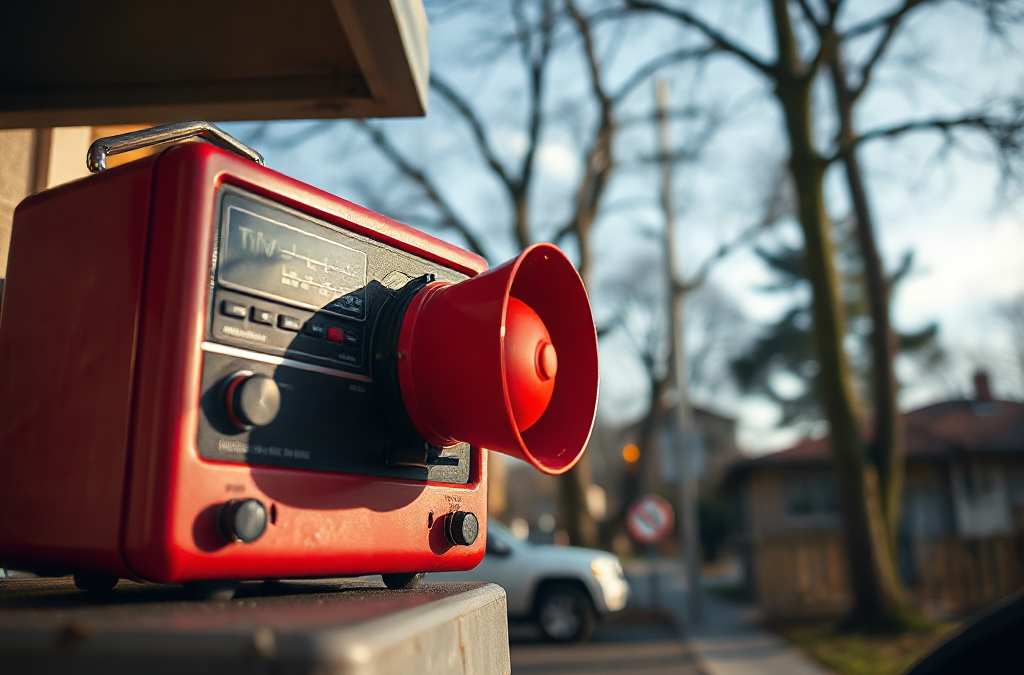
Manual methods for receiving official alerts without internet include battery or hand-crank radio broadcasts, outdoor warning sirens, public-address announcements, posted notices, and prearranged phone or in-person contact trees. Radio is usually the most useful home method because it can deliver detailed instructions, while sirens and loudspeakers provide rapid local warnings but may not explain the hazard or required action. Keep a battery-powered radio ready, learn which alert sounds your local sirens use, identify trusted nearby messengers, and verify information through more than one offline source. Do not assume a siren means evacuation, or that a failed phone call means no message exists; power loss, congestion, distance, and building materials can interrupt individual channels.
Which Offline Alert Channels Carry Useful Detail
Offline emergency communication works best as a layered system rather than a single substitute for internet access. Official radio broadcasts, outdoor sirens, vehicle loudspeakers, public-address systems, printed notices, and trusted person-to-person messages each carry different amounts of information. A siren may tell you that an urgent hazard exists nearby, whereas a radio announcement may identify the affected area, protective action, shelter location, road closure, or time of the next update.
The difference matters because people often treat every signal as equally complete. A siren is designed to attract attention across a broad area, not to explain whether residents should shelter indoors, avoid a particular road, or leave immediately. Loudspeaker announcements can add words, but wind, traffic, closed windows, and building insulation may make them difficult to understand. Printed notices are slower but can preserve instructions after a broadcast has ended.
Begin by identifying the official channels used in the specific place where you live, work, or stay. Local emergency management offices, fire departments, public safety agencies, and broadcasters commonly publish information about siren meanings, designated radio stations, reception areas, and emergency meeting points. Save that information on paper rather than relying on a website that may be unavailable during a power or network outage.
A practical offline information map should record the source, coverage, detail, and likely failure point for each channel:

- Radio: detailed instructions, but dependent on batteries, reception, and a functioning broadcast service.
- Sirens: fast local attention, but often limited or ambiguous meaning.
- Public announcements: potentially specific, but easy to miss or mishear.
- Printed notices: durable and reviewable, but delayed and dependent on someone distributing them.
- Contact networks: useful for reaching people who missed a broadcast, but vulnerable to rumors and individual mistakes.
Use the internal reference manual methods for receiving official alerts without internet as a planning reminder, but confirm local procedures through the responsible public agency. An offline method is only useful if the household knows what the signal means and what action follows it.
Building a Reliable Radio and Siren Routine
A battery-powered or hand-crank radio is usually the strongest household tool for receiving detailed official information without internet access. Choose a model that receives the broadcast bands used locally, then test it from the rooms where it may be needed. Reception can differ sharply between an upper floor, basement, interior room, and exterior wall. A radio that works clearly beside a window may produce static in a reinforced concrete room.
Store spare batteries separately from the radio so corrosion does not damage both supplies at once. If the device has a charging function, treat that feature as backup rather than assuming it replaces batteries. Write the relevant station frequencies, call signs, and local agency names on a card attached to the radio. During an incident, searching through stations can waste time and expose the listener to unofficial speculation.
Sirens require a different preparation method. Ask the local authority what each tone, duration, or repeated pattern means, and whether an all-clear signal is used. Some communities use sirens for multiple hazards; others reserve them for a narrower purpose. Never invent meaning from the sound alone. If the local explanation says the siren means to seek more information, do not automatically interpret it as an evacuation order.
Run a short household drill under realistic conditions. Place the radio where it is stored, use only its normal power source, and have someone read the written station card aloud. Then ask each person what they would do after hearing a siren but before receiving detailed instructions. This reveals practical failures such as dead batteries, missing glasses, an unreadable frequency card, or disagreement about where to listen.
A common mistake is testing equipment only once. Batteries discharge, knobs move, antennas break, and stations change procedures. A modest monthly check is more useful than a sophisticated device that remains untouched for years. Check the radio, spare batteries, written frequencies, flashlight, and paper instructions together. Keep the set accessible during a storm or other event; a device locked in a vehicle or buried in storage may be operational but functionally unavailable.
Using Contact Trees, Door-to-Door Messages, and Posted Notices
Person-to-person communication fills gaps that broadcasts cannot. A contact tree assigns each person a small number of neighbors, relatives, coworkers, or household members to reach through an agreed offline method. That method might be a landline call, a visit to a designated address, or a message carried by a specific runner. The arrangement should state who initiates contact, what words identify an official instruction, and where people go if they cannot reach anyone.
Contact trees are not substitutes for official sources. Their value is distribution: one person who hears a radio instruction can help someone who is elderly, hearing impaired, away from a radio, or unfamiliar with the local language. The risk is distortion. A message such as “leave the eastern zone using Route 4” can become “everyone must leave immediately” after passing through several people. Use short, exact wording and require the recipient to repeat the instruction back.
Paper notices and community message boards can provide a stable reference when people miss a moving announcement. Useful notices should show the issuing agency, date and time, affected location, action requested, and next update point. A handwritten sheet with no source or timestamp should be treated as unverified, even if it appears on an official-looking door or pole.
Door-to-door communication is particularly valuable in neighborhoods where sirens are difficult to hear indoors. It also has limits: volunteers may not reach every building, hazardous areas may be inaccessible, and a messenger may carry incomplete information. Never send an untrained person into a restricted or dangerous area merely to confirm a rumor. A safer arrangement identifies a nearby check-in point outside the hazard zone.
Prepare a paper contact card with names, addresses, landline numbers if available, meeting locations, accessibility needs, and language preferences. Keep one copy at home and another with a responsible contact. Review it after moves, job changes, or changes in household composition. The internal link manual methods for receiving official alerts without internet is most useful when paired with this local, human distribution layer.
Verifying Instructions and Acting on Incomplete Information
Offline alerts often arrive with missing context, so verification should focus on source, time, location, and requested action. A trustworthy message identifies who issued it or points back to a known official channel. It should make clear whether it applies to your area, when it was issued, and what residents should do next. If one of those elements is absent, do not fill the gap with guesswork.
Use two independent channels when the situation allows. For example, a siren can prompt you to turn on the designated radio station, while a neighbor can confirm that the sound was heard across the district. Two people repeating the same rumor are not independent confirmation if both received it from the same unknown source. A radio announcement and a posted notice from the responsible agency provide stronger corroboration.
Do not delay a clearly stated urgent protective action while seeking perfect confirmation. The sensible balance is to act on a direct official instruction and verify details that affect route, timing, or destination. If a message says to shelter indoors because of an external hazard, move inside and close openings while listening for more specific information. If it says to evacuate a named zone, follow the stated route rather than selecting a shortcut based on hearsay.
Record important updates on paper with the time, source, location, and action. Written notes prevent an early message from being confused with a later revision. They also help household members who were asleep, outside, or away from the radio. Mark canceled instructions clearly instead of crossing them out so the sequence remains understandable.
Weak assumptions create avoidable danger. Silence does not mean the hazard has ended; a broadcast transmitter, siren, or messenger may have failed. A familiar voice does not prove accuracy, and an official-sounding vehicle announcement may be hard to understand at a distance. If the signal is unclear, seek the designated official channel, move away from the suspected hazard when appropriate, and avoid spreading an unverified claim. More planning detail is available through manual methods for receiving official alerts without internet, especially when a household needs a written decision sequence.
Frequently Asked Questions
What is the most useful offline alert method at home?
A battery-powered or hand-crank radio is often the most useful because it can provide detailed instructions, but it should be paired with local siren knowledge and written agency information.
Can a siren tell me exactly what to do?
Usually not. Learn the local siren meanings, then use the designated radio station or official announcement channel for the hazard, location, and required action.
How should a neighborhood contact tree work?
Assign each person a small set of contacts, specify the initiating source and exact wording, and provide a meeting location if calls or visits fail.
How can I identify an unreliable paper notice?
Check for the issuing agency, date and time, affected area, requested action, and a way to confirm the message. Missing details make the notice unverified.
What should I do if official information is incomplete?
Follow any clear protective instruction, avoid spreading assumptions, write down the source and time, and continue monitoring the designated official channel for updates.
Further Reading
Authoritative Sources
- Ready.gov
ready.govOfficial household preparedness guidance, emergency plans, and supply checklist resources.
- FEMA
fema.govFederal emergency management information, disaster planning resources, and recovery guidance.
- American Red Cross Emergency Preparedness
redcross.orgPractical emergency preparation, safety, and response guidance for households.
- CDC Emergency Preparedness and Response
cdc.govPublic health guidance for disasters, emergency response, and recovery conditions.
Conclusion
Receiving official alerts without internet access depends on preparation before the signal arrives. Keep a tested radio with spare power, record local frequencies and siren meanings, and maintain a paper contact network that can reach people who miss broadcasts. Treat each channel according to its strengths: sirens attract attention, radio supplies detail, notices preserve instructions, and personal contacts extend reach. Verification should check the source, time, location, and requested action without delaying a plainly stated urgent protective measure. Review the system periodically, replace damaged supplies, and practice locating the radio and contact card in low-light conditions. That modest routine turns disconnected devices and local relationships into a more dependable warning system when online services are unavailable.




