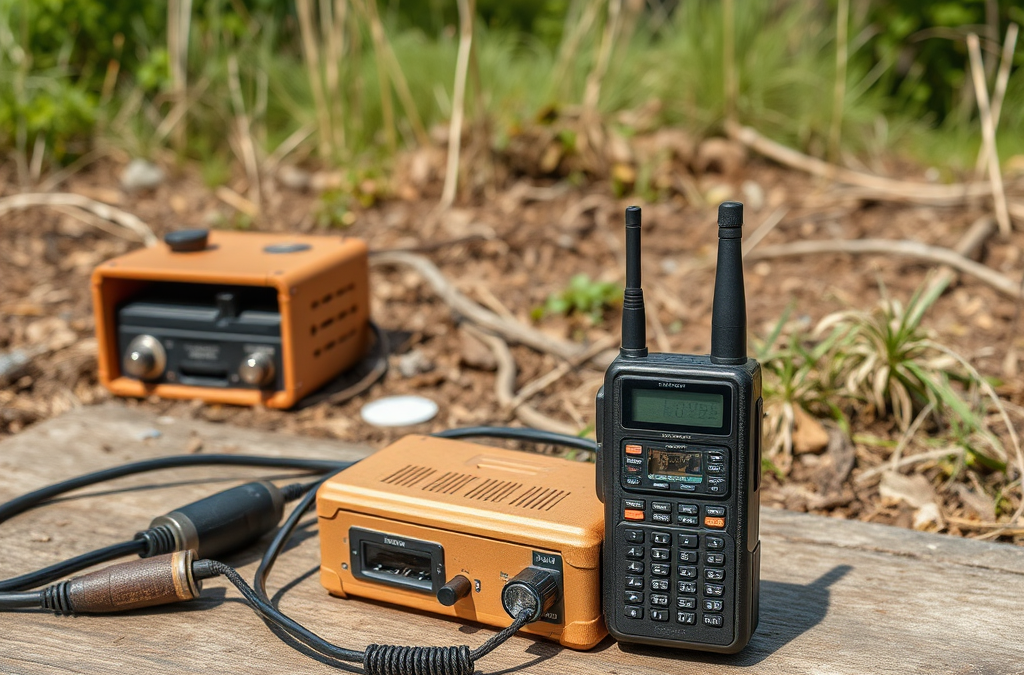
Communication relays that work when cellular networks fail include amateur and commercial two-way radios, mesh-network nodes, satellite messengers, satellite phones, and locally managed radio repeaters. Radios can maintain nearby voice contact without towers, mesh devices can pass short messages between linked nodes, and satellite equipment can reach beyond a damaged regional network when it has a clear view of the sky. Each option has limits: radios depend on distance and terrain, mesh systems need enough participating nodes, and satellite devices require power, sky access, and sometimes an active service plan. A practical setup uses one local relay and one geographically independent backup, then tests both before an outage.
What Fails When Cellular Service Goes Down
Cellular failure does not always mean that every communication path has disappeared. A damaged tower, overloaded local network, extended power outage, backhaul interruption, or deliberate service shutdown can prevent phones from registering even while other radio or satellite systems remain usable. The first planning decision is therefore to separate the failed dependency from the communication task: local coordination, regional contact, or communication with someone outside the affected area.
A phone may show signal bars yet fail to place a call because the network is congested. Text messages may queue for a long time, and internet-based messaging may fail if both cellular data and local broadband depend on the same damaged infrastructure. A relay avoids some of these bottlenecks by receiving a message through one path and forwarding it through another. That relay might be a handheld radio operator, a fixed repeater, a mesh node on a nearby building, or a satellite terminal.
Distance, terrain, power, licensing, and operator availability determine whether a relay is useful. A neighborhood separated by a ridge may need a higher antenna or an elevated relay even if the straight-line distance is modest. A mesh network may work well in a dense area with many powered nodes but provide little coverage in a rural setting with only two devices. Satellite equipment solves the distance problem more effectively, but it introduces sky visibility, battery, subscription, and weather-related constraints.
Before buying equipment, write down who must communicate, how far apart they are, what information they need to exchange, and how long the system must operate. A household checking on relatives nearby has different requirements from a volunteer team coordinating across a county. The useful comparison is not simply which device is strongest; it is which relay survives the specific point of failure.

Readers building a broader plan can also review communication relays that work when cellular networks fail alongside a written contact card and a prearranged meeting location. Those non-digital details matter when every electronic option is unavailable.
Radio Relays for Nearby Voice Communication
Two-way radios are often the most practical relay for short-range coordination because they can communicate directly without a cellular tower. Family-service radios, business radios, amateur radios, and professional public-safety systems differ in range, controls, licensing, and interoperability. A radio advertised with a long maximum range may perform much less effectively inside buildings, behind hills, or among dense trees.
A repeater extends radio coverage by receiving a transmission on one frequency and retransmitting it on another, usually from an elevated location. The height of the antenna often matters more than extra handheld power. A community repeater on a hill may connect users across a town, while two high-powered handheld units at street level may still struggle around concrete structures. Repeaters also need a functioning site, backup power, correct programming, and someone who understands its operating rules.
Consider a storm-damaged neighborhood where four volunteers inspect streets within several miles of a community center. Direct radio communication may be enough for the closest teams. If a ridge blocks the farthest streets, an elevated mobile unit or established repeater could close the gap. A satellite messenger would provide geographic independence, but it may be slower for rapid voice coordination and less convenient when several people need to hear the same update.
Common radio mistakes include assuming all radios can talk to one another, leaving channels unprogrammed, and relying on privacy features that are not true encryption. Users should confirm compatible frequencies or channels, antenna connections, charging methods, and lawful operating requirements before an outage. A simple call-sign convention and short message format reduce confusion: identify the recipient, state location, give the status, and repeat any critical number.
Radio is strongest when the group is local, operators can hear one another, and a relay location has been selected in advance. It is weaker when the group is scattered across a large region or when no one is available to monitor the channel. For those limits, combine local radios with a second relay path that does not share the same tower or power source.
Mesh Networks and Store-and-Forward Messaging
Mesh communication devices pass data from one node to another rather than sending every message directly to a cellular tower. A message can hop through nearby phones or dedicated nodes until it reaches the intended recipient. Some systems support live relaying when a connected path exists; others use store-and-forward behavior, holding a message until a participating device comes within range.
The relay mechanism makes mesh systems useful in neighborhoods, outdoor groups, and response teams where users are distributed across a limited area. A node placed on an upper floor may reach farther than a device carried at ground level. However, every hop consumes battery and adds a possible point of failure. If one critical node is switched off, moved indoors, or separated from the others, the network may split into isolated clusters.
Imagine a hiking group spread along a trail after a landslide blocks the road. Cellular service is unavailable, but several members still carry compatible mesh devices. Short status messages may travel between the groups as long as the spacing remains within radio range. The group should not assume that a message delivered to one nearby device has reached a distant coordinator; delivery indicators, route visibility, and a planned acknowledgment process are more reliable than silence.
Mesh systems are not automatically private, universal, or independent of infrastructure. Some require a companion phone, an application, or internet access for certain features. Bluetooth-based systems may cover only short distances, while longer-range low-power radios trade speed for reach. Buildings, hills, radio interference, and sparse participation can reduce performance. The most useful predeployment test places nodes where they would actually be used rather than testing them only across an open parking lot.
Choose mesh when the people who need to communicate are likely to remain within a connected area and can keep nodes powered. Choose direct radio when voice traffic and immediate group awareness matter more than text convenience. Choose satellite for a small number of critical messages that must leave the local region. A layered plan works better than treating one mesh application as a universal replacement for every service.
Satellite Links and Layered Backup Planning
Satellite messengers and satellite phones bypass local cellular infrastructure by communicating with satellites, making them valuable when a regional outage isolates an area. Satellite messengers usually favor short text updates and location sharing, while satellite phones provide voice service where the device, subscription, satellite coverage, and environment support it. Some newer devices combine satellite messaging with ordinary cellular or Wi-Fi functions, so users must understand which mode is active.
Satellite equipment needs a reasonably unobstructed view of the sky, adequate battery capacity, and time to acquire a connection. Deep valleys, heavy structures, dense canopy, and poor device placement can delay or prevent transmission. A message sent from beside a window may work when one sent from a basement does not. Users should follow the device maker’s instructions for orientation, message confirmation, emergency features, and service-plan limits rather than assuming that an unsuccessful attempt is proof of network failure.
A satellite link is geographically independent from a failed cell tower, but it is not failure-proof. Devices can be lost, damaged, discharged, or locked behind an expired plan. Subscription fees may make it impractical to issue one to every member of a large group. Satellite voice also requires disciplined airtime use; a brief status report may be more dependable and economical than an extended conversation.
A sensible layered arrangement assigns each technology a defined job. Local radios can handle rapid coordination between nearby people. Mesh devices can carry short messages across a cluster of users. Satellite equipment can send a priority update to someone outside the affected area or request assistance when local relays are unavailable. Written contact procedures should specify which channel is tried first, how long the group waits, and what information is included in an escalation message.
Do not place every relay at the same location. A repeater and charging station in one building share the same exposure to fire, flooding, theft, and generator failure. Separating equipment, keeping one device with a mobile team, and maintaining a paper list of key numbers improve resilience. The goal is not uninterrupted convenience; it is a reasonable chance of getting essential information through by another route.
Testing, Power, and Operating Discipline
Communication relays become dependable through rehearsals that expose weak assumptions before an outage. Test the complete chain: device, antenna, relay, receiving operator, power source, and message acknowledgment. A radio that transmits clearly to a neighbor may fail to reach the intended relay from a basement. A satellite messenger that works outdoors may not work from the planned shelter location.
Run tests at different times and from the locations where people will actually stand. Record dead zones, successful call signs, charging intervals, and the time required for a message to receive confirmation. For mesh equipment, remove one node from the route and see whether traffic can still pass. For a repeater, confirm the backup power arrangement and identify who is responsible for restoring or monitoring it.
Power planning deserves the same attention as equipment selection. Store charged battery packs, appropriate cables, vehicle adapters, and a small independent charging source. Keep batteries away from damaging heat and follow manufacturer storage guidance. A large battery bank may support a fixed relay for longer, while smaller packs are easier for mobile operators to carry. Avoid concentrating every charger on a single outlet or generator circuit.
A compact operating checklist should cover:
- Which relay is used for local voice, local text, and outside contact.
- Where each device is stored and who carries it.
- Channel names, call signs, message format, and acknowledgment rules.
- Battery rotation, charging locations, and backup power limits.
- The condition that triggers a change to the next communication method.
Failure often comes from behavior rather than electronics. Long unstructured transmissions occupy shared channels, vague locations delay help, and unacknowledged messages create false confidence. Use plain language, keep sensitive information off open channels, and repeat addresses or coordinates carefully. A short, practiced procedure will outperform a sophisticated relay that nobody knows how to operate.
For a final planning pass, connect equipment choices to a documented communication schedule and review the plan whenever household members, vehicles, buildings, or service subscriptions change.
Frequently Asked Questions
What is the simplest relay for nearby households?
Compatible two-way radios are usually the simplest option for nearby voice contact, provided users test range, understand channel operation, and account for terrain and building materials.
Can mesh devices work with no internet connection?
Some mesh systems can relay local messages without internet access, but capabilities vary. Check whether the system needs a phone application, participating nodes, or an internet connection for delivery outside the local mesh.
Are satellite messengers guaranteed to work during a disaster?
No. They may be useful when cellular infrastructure fails, but blocked sky views, depleted batteries, damaged devices, service-plan limits, and satellite or provider problems can interrupt communication.
Does a radio repeater work without electricity?
A repeater needs power at its site unless it has a suitable backup system. Confirm its battery or generator arrangement, operating duration, and the person responsible for monitoring it.
What information should an outage message contain?
State who you are, where you are, what has happened, what assistance or confirmation is needed, and when you will communicate again. Use plain language and repeat critical addresses or numbers.
Further Reading
Authoritative Sources
- Ready.gov
ready.govOfficial household preparedness guidance, emergency plans, and supply checklist resources.
- FEMA
fema.govFederal emergency management information, disaster planning resources, and recovery guidance.
- American Red Cross Emergency Preparedness
redcross.orgPractical emergency preparation, safety, and response guidance for households.
- CDC Emergency Preparedness and Response
cdc.govPublic health guidance for disasters, emergency response, and recovery conditions.
Conclusion
A resilient communication plan matches each relay to the distance, message type, and failure it must withstand. Two-way radios are practical for nearby voice coordination, mesh networks can move short messages through a populated local area, and satellite devices provide a valuable route beyond a damaged regional network. None should be treated as automatic coverage: terrain, sky visibility, battery capacity, repeater power, subscriptions, and trained operators all affect results.
Choose one primary method and one independent backup, assign each a clear purpose, and test the full route from the real operating location. Write down channels, call signs, contact priorities, acknowledgment rules, and the point at which the group changes methods. That preparation turns disconnected devices into a relay plan that remains useful when cellular networks fail.
Related Content
- Planning for the Unexpected: Top Tips for Effective Emergency Preparedness
- Top 10 Essential Emergency Supplies to Buy in 2025 for Safe Preparedness
- The Hidden Costs of Prepping Supplies: Understanding Long-Term Financial Implications
- The Impact of Seasonal Weather on Prepping Efforts: Key Strategies for Different Conditions
- 10 Effective disaster preparedness resources to stay safe in 2025