
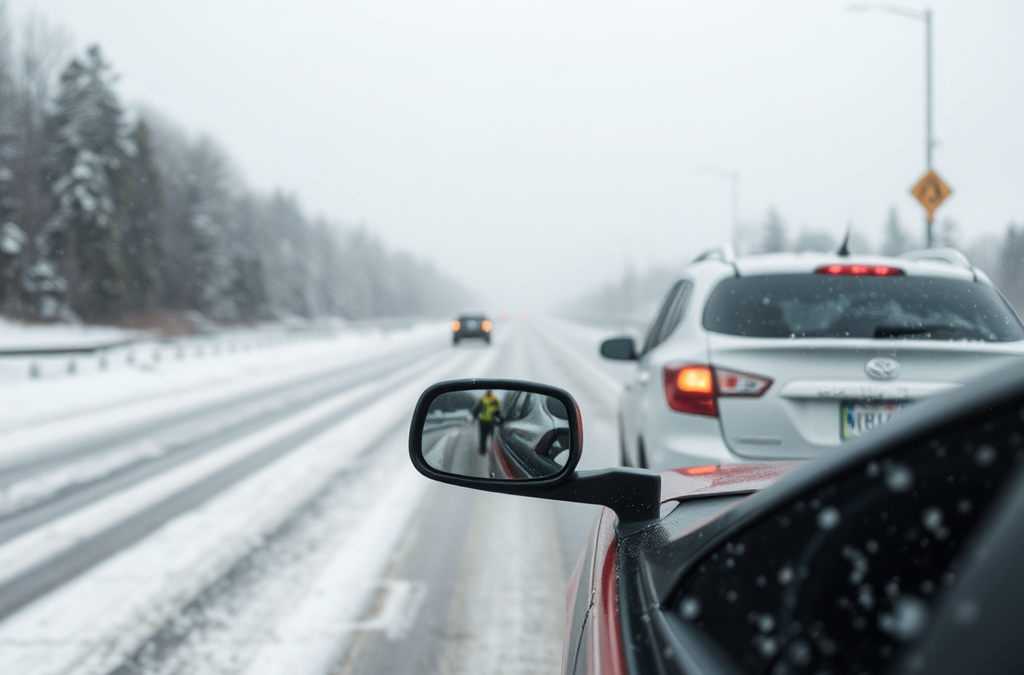
Select a departure trigger before roads deteriorate by combining a forecast threshold, a route-specific hazard, and the latest safe time needed to leave—not by waiting for visible flooding or an official order. Set the trigger around conditions such as forecast freezing rain, rising water near the road, a wildfire perimeter change, bridge closure, or a verified loss of your primary route. Add travel time, vehicle limitations, fuel access, mobility needs, and a reserve for delays. A trigger should produce a clear action: leave by a stated time, use a named alternate route, or relocate before conditions make travel slower and less predictable.
Define the Road Condition That Changes Your Decision
A useful departure trigger is a preselected condition that changes the safety or reliability of travel. It should describe something observable, such as water reaching a known low crossing, a forecast of ice beginning during the return journey, authorities closing a bridge, or smoke reducing visibility along the only practical route. “Leave if things get worse” is not a trigger because it leaves the meaning of worse to a stressed decision-maker at the least useful moment.
The trigger should be tied to the hazard affecting your route rather than to the general severity of an event. A winter storm may be manageable on a treated highway but dangerous on an untreated rural road. Heavy rain may not affect an elevated route while making a nearby underpass impassable. For how to select a departure trigger before roads deteriorate, identify the specific road feature that can remove your margin: a steep hill, exposed bridge, narrow lane, flood-prone dip, debris-prone pass, or junction where traffic has few alternatives.
Use three levels when a single yes-or-no decision feels too crude. A monitoring threshold might mean checking official updates more often. A preparation threshold might mean loading the vehicle, moving essential items near the door, or confirming the destination. A departure threshold means the trip begins. This layered approach avoids both premature travel and last-minute hesitation.
For example, a household near a creek crossing might monitor when rainfall warnings are issued, prepare when water begins covering the shoulder, and depart before the crossing is reported as flooded. A person who waits for water on the pavement may already be too late because visibility, depth, and traffic conditions can change faster than a route can be reassessed. Never assume a familiar road remains safe simply because it was passable earlier.

Set a Departure Time From Travel Constraints
The departure trigger must leave enough time for the entire trip, not merely the moment of pulling out of the driveway. Estimate the normal travel time, then account for reduced speeds, congestion, blocked intersections, fuel stops, loading, communication delays, and the possibility that an alternate route is required. The practical trigger is the point at which continuing to wait would consume the margin needed to complete the journey safely.
Work backward from a meaningful deadline. If roads are expected to become hazardous at 7 p.m. and the route normally takes 90 minutes, leaving at 5:30 p.m. may be inadequate if traffic is likely to slow or the vehicle cannot safely use the alternate road. Someone traveling with children, an older adult, medical equipment, animals, or a vehicle with limited traction may need an earlier threshold than a solo driver on a well-maintained route. The difference is not alarmism; it reflects different travel speeds and stopping options.
Separate a forecast time from a personal leave-by time. Forecasts describe regional conditions and may not capture the exact moment a local road fails. A leave-by time is your operational deadline, based on route length and constraints. If the departure decision depends on reaching a destination before darkness, a bridge closure, or the onset of freezing temperatures, write that deadline down rather than trying to calculate it during an unfolding event.
Shorter routes are not automatically safer. A direct road may cross a low bridge, while a longer route stays on higher ground and has more services. Compare route reliability, not just mileage. A route with fewer junctions may reduce navigation errors, but a route with several alternatives may be more resilient if one segment closes. Check fuel before the trigger arrives; leaving with a nearly empty tank can turn a manageable detour into a forced stop in worsening conditions.
- Travel margin: Allow time for slower speeds, queues, and a missed turn.
- Vehicle margin: Match the route to clearance, traction, fuel range, and mechanical condition.
- Personal margin: Include loading time, rest needs, accessibility, children, pets, or medication.
- Route margin: Identify where a closure would remove the last viable alternative.
A common mistake is choosing a trigger based only on the forecasted hazard peak. The peak may occur after roads have already become difficult, while road conditions can deteriorate before the official start time because of local drainage, shade, wind exposure, or traffic. Build the trigger around the earliest condition that threatens your ability to leave, not the most dramatic point in the weather report.
Build Triggers From Reliable, Local Signals
Use information sources in a hierarchy. Official emergency management notices, transportation agencies, road closure systems, weather services, and local law enforcement updates generally provide stronger decision evidence than an unverified social media post. Local observations still matter, particularly for flooding, fallen trees, and ice, but treat a single report as a prompt to verify rather than as proof that every route has failed.
Different hazards require different signals. For flooding, watch official road closures, water levels where available, rainfall intensity, and reports from recognized local agencies. For winter weather, look at road treatment status, pavement temperature information when published, freezing-rain timing, visibility, and whether the route includes steep or exposed sections. For wildfire or smoke, monitor evacuation zones, road restrictions, wind direction, and changes in the designated route. For landslides or debris, prioritize closure notices and reports about falling material; a road can appear open while remaining unstable.
Do not treat an alert level as a universal instruction to leave. Advisory language varies by agency, and a regional warning may cover places with very different road conditions. Translate the alert into a route question: What does this mean for the road I will use, the time I need, and the destination receiving me? If an official order applies to your location, follow it rather than waiting for your personal threshold. A personal trigger is a planning aid, not permission to disregard an evacuation directive.
Set a confirmation rule before the event. For instance, you might leave when an official closure affects the primary route, when a trusted road report confirms hazardous conditions at a critical segment, or when the forecast places the deterioration window inside your calculated travel period. Keep the rule simple enough to apply while phone service is unreliable. Save maps, addresses, agency phone numbers, and route notes offline. Selecting a departure trigger before roads deteriorate is less effective if the information needed to activate it disappears with the network.
Another failure mode is collecting too many signals without deciding which one controls the action. A long list of weather apps can create false precision and invite endless postponement. Choose one primary official source, one transportation or closure source, and one local observation method. Record the time of each update. If sources conflict, favor the report closest to your route and the information that reflects actual road status, while choosing the safer interpretation when uncertainty affects a critical crossing or narrow escape window.
Test the Plan Before Leaving Becomes Difficult
A trigger is ready only when it produces an immediate sequence of actions. Write the condition, the response, the route, and the destination in plain language. “If the county closes the low bridge, depart using Route B and notify the destination” is operational. “If flooding worsens, consider leaving” is not. Include who makes the final decision, especially if several adults may receive different information.
Run a short rehearsal under normal conditions. Confirm that everyone knows where the keys, documents, medicines, chargers, water, and pet supplies are stored. Check that the vehicle can start, has adequate fuel, and can use the intended route. A route plan that depends on a trailer, a narrow driveway, or a vehicle parked behind another car should be corrected before the trigger is reached. Practice loading without blocking access to the vehicle or leaving essential items behind.
Use a primary route and at least one realistic alternative, but do not assume every alternate is usable. Examine road class, bridge exposure, elevation, seasonal closures, cellular coverage, and places where a turn cannot be safely made. A longer alternative may be preferable if it avoids a known bottleneck, but it can be a poor choice if fuel or shelter is unavailable. Mark the point at which you will stop improvising and seek a safe location rather than driving into uncertain conditions.
Review the trigger as conditions change. A route may be more crowded than expected, a destination may lose access, or an official closure may remove the original alternative. The correct response is not to keep the old plan out of loyalty to it. Recalculate from the information available, and avoid entering water, smoke-obscured roads, debris fields, or visibly icy sections simply because the departure threshold was already crossed.
Signs that the plan is working include a clear leave-by time, a destination that has confirmed access, and a route decision that does not require live debate. Signs that it is failing include repeated checking without action, contradictory route names, low fuel, missing medication, or dependence on a road report that is hours old. Correct those weaknesses before the hazard reaches the roadway. The purpose of this departure-trigger method is to preserve choices while choices still exist.
Further Reading
For route-specific decisions, consult your local transportation department, emergency management office, and national weather service before travel. Their closure notices, warnings, evacuation maps, and road-condition updates are more useful than generalized advice because they connect the hazard to actual locations and operating restrictions.
Frequently Asked Questions
How early should a departure trigger be set?
Set it early enough to cover normal travel, likely delays, loading, and at least one route problem. People with mobility, vehicle, or destination constraints should use a larger margin.
Should an official evacuation order replace a personal trigger?
Yes. Follow an applicable official order rather than waiting for a personally chosen threshold. Personal triggers are intended for earlier planning and voluntary movement.
What makes a road condition a good trigger?
A good trigger is observable, route-specific, and linked to a clear action, such as a closure, rising water at a crossing, or forecast icing during the trip.
How should conflicting travel updates be handled?
Prioritize current information from the agency responsible for the road, verify the report when possible, and use the safer interpretation when uncertainty affects a critical route segment.
Is the shortest route usually the best evacuation route?
No. Compare elevation, bridges, bottlenecks, fuel access, closures, and alternate options. A longer route may offer a wider safety margin or more reliable road conditions.
Further Reading
Authoritative Sources
- Ready.gov
ready.govOfficial household preparedness guidance, emergency plans, and supply checklist resources.
- FEMA
fema.govFederal emergency management information, disaster planning resources, and recovery guidance.
- American Red Cross Emergency Preparedness
redcross.orgPractical emergency preparation, safety, and response guidance for households.
- CDC Emergency Preparedness and Response
cdc.govPublic health guidance for disasters, emergency response, and recovery conditions.
Conclusion
A dependable departure trigger turns a vague concern about deteriorating roads into a decision that can be acted on. Choose a route-specific condition, calculate the time required for your actual travelers and vehicle, and connect the threshold to authoritative road and hazard information. Prepare the vehicle, destination, offline route details, and alternate path before the trigger is reached. Keep the wording simple enough that another person can apply it without guessing. Most importantly, treat visible road failure as a late warning rather than the starting point for action. Leaving while the route still has capacity preserves fuel options, detours, communication, and the ability to stop safely if conditions change. Review the trigger whenever forecasts, closures, or destination access changes.
Related Content
- Storm Survival Kits: 9 Lifesaving Parts Of Equipment
- How to Stay Safe in Disaster: Essential Steps for Creating a Personal Emergency Plan
- Emergency Preparedness Checklist: Are You Ready
- How to Build a 72-Hour Emergency Kit: The Ultimate Guide
- The Ultimate Guide to the 72 Hour Emergency Kit: 7 Effective Tips for 2025




